redtel-blutdruck.de/en/smartwatch/calibration
Why does a smartwatch need calibrating?
Because it measures no pressure. A smartwatch records light and time and derives from them a curve that changes with blood pressure — but not a value in millimetres of mercury. Only the calibration tells the device which signal state corresponds to which pressure. How well it does that decides whether the displayed number still holds outside of rest.
4 min read Updated 4 September 2026 39 articles · 4 videos · 1 publication
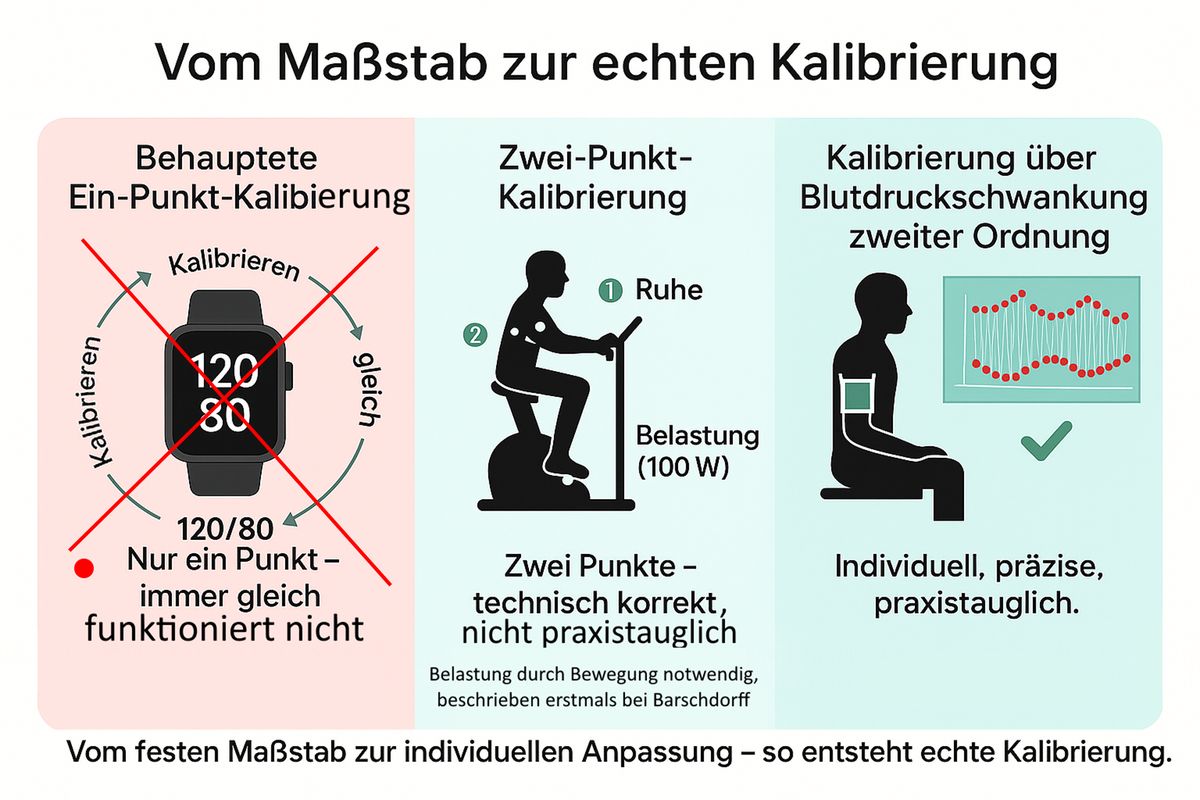
What calibration actually means
To calibrate is to line a measuring system up with reality. That always takes at least two states with a measurable difference between them.
A ruler without two marks is not a scale, it is a piece of wood. A thermometer that knows a single point can say "as warm as back then" — but not how warm it is now.
A watch is no different. It delivers a curve that changes. Without a reference, that curve stays a curve.
The usual way: one measurement at rest
Almost every wearable calibrates with a single reference value. It takes one cuff measurement, seated, at rest — and computes onward from there.
That describes one state. Everything above and below it is extrapolation: the device has never seen those states and has nothing to compare them with.
Several measurements do not help, as long as all of them are taken at rest. Ten points in the same place are still one point.
The second point is in every measurement already
Blood pressure moves with the breath. This second-order blood pressure variation delivers a higher and a lower pressure state within a single measurement phase — exactly the two states a calibration asks for.
It is not a disturbance of the measurement but part of one's own circulatory regulation, and it comes out differently in every person. That is precisely what makes it usable as a personal calibration profile.
One point becomes a line. And a line also describes what happens between rest and exertion.
What this means for manufacturers
- The sensor is not the bottleneck
- Optical sensors in current watches deliver a usable signal. What is missing is the reference it is tied to.
- One logic, several device classes
- A calibration built on a physiological process rather than on a device applies to a watch, a ring and a sensor platform alike.
- No extra hardware
- The breath-driven variation is present in every measurement. It has to be recorded, not produced.
- Comparability
- Only a shared reference makes readings from different devices comparable at all — that is the point of a standard, and the reason this work aims at one.
The subject on video
 VIDEO 175
Calibrating Wearables with What Interferes with Blood Pressure Measurement.
0:30
VIDEO 175
Calibrating Wearables with What Interferes with Blood Pressure Measurement.
0:30
 VIDEO 177
Wearables Need Calibration: Exercise or Breathing for Stress-Free Continuous Blood Pressure Measurement?
0:18
VIDEO 177
Wearables Need Calibration: Exercise or Breathing for Stress-Free Continuous Blood Pressure Measurement?
0:18
 VIDEO 191
Initialization Is Not Calibration – Transparency Instead of a Black Box
0:38
VIDEO 191
Initialization Is Not Calibration – Transparency Instead of a Black Box
0:38
 VIDEO 164
A score looks precise. But without calibration, its number has no medical scale.
0:40
VIDEO 164
A score looks precise. But without calibration, its number has no medical scale.
0:40
Evidence
Related questions
- Why is a signal not yet a measurement? /knowledge/signal-and-reference
- What does an optical sensor actually measure? /knowledge/optical-sensor
- Why does no device measure blood pressure continuously? /blood-pressure/continuous
- How does my watch know that was a heartbeat? /knowledge/raw-signal
- How can I check whether my wearable really measures? /smartwatch/function-test
What lies behind this page
This page replaces none of these articles. It answers what people search for and leads from there into the material. All articles remain reachable under their existing addresses.
Read further
-
 The problem with wearables is missing or incorrect calibration.
-
 Breathing calibrates wearables.
-
 The image demonstrates the mathematical and technical limitations of static single-point calibration for representing dynamic blood pressure behavior.
-
 Wearables are not the problem in achieving reliable continuous blood pressure monitoring.
-
 Calibrating only while stationary is incorrect.
-
 What is missing from a proper blood pressure calibration?
33 further texts on this subject
-
 Proposal for Verifying the Functional Performance of Wearables Transparent. Reproducible. Verifiable.
-
 AI cannot invent a reference or calibration.
-
 What are blood pressure-dependent trend data—and how do they become blood pressure information?
-
 Blood pressure starts with calibration. Not with a waveform.
-
 How do the numbers get onto the PPG as blood pressure? A waveform alone does not contain systolic or diastolic blood pressure.
-
 PPG Detects Change. But Change of What? Only calibration turns a PPG signal into an assigned blood pressure value.
-
 Initialization or Calibration? Why These Definitions May Determine the Regulatory Path of Future Blood Pressure Technologies
-
 How do I calibrate correctly? Individual blood pressure calibration for wearables – comparable, effort-free and suitable for everyone.
-
 You measure signals. We turn them into effortless blood pressure monitoring. Calibration determines function.
-
 Effortless Blood Pressure Monitoring – Calibration Determines Function
-
 Calibration of Blood Pressure Dependent Signals (BPDS): How Change Profiles and Second-Order Blood Pressure Variability Enable Blood Pressure Values
-
 Calibration Logic and Calibration Profile – from second-order blood pressure variation to stress-free continuous blood pressure monitoring
-
 Calibration Requires Interaction. From Static to Dynamic Blood Pressure Measurement in Continuous, Stress-Free Blood Pressure Monitoring.
-
 Polarity Describes States. Interaction Describes Relationships. Why Calibration Requires More Than Observing Individual Changes.
-
 The Bridge of the ISO 81060 Series – Calibration Logic Based on Second-Order Blood Pressure Variations
-
 The Global Market – One Calibration Logic. Multiple Device Categories. One Calibration Profile for Intelligent Systems and Future Medical Devices.
-
 The foundation for continuous, stress-free blood pressure measurement.
-
 Why must the BPER match the invasive reference?
-
 How does a smartwatch become a medical device ?
-
 It's the calibration that counts...
-
 Oura, A signal is not a measurement.
-
 Blood Pressure or Just Marketing?
-
 Is an optical signal already blood pressure?
-
 HRV is unclear. That is a fact.
-
 HRV: Without context, it holds no value.
-
 The same HRV. A completely different state.
-
 HRV Stumbles in the Dark.
-
 HRV defined—provided it is calibrated.
-
 Individual calibration instead of generalized estimation.
-
 Paper 1 does not simply describe another calibration method.
-
 How can Smartwatches...
-
 How can Smartwatches...
-
 At rest, the cardiovascular system works differently than under physical load